This article contains affiliate links. If you buy through one of them we may earn a small commission at no extra cost to you. How this works.
Your evening routine does not need candles, a bath, and a forty-five-minute skincare sequence to be worthwhile. It just needs to help you shift gears — from the busy, reactive state of the day into something quieter and more settled. A few simple habits, done consistently, can make the end of your day feel like it actually belongs to you.
Why evenings are worth thinking about
The way you spend the last hour or two before bed tends to set the tone for how you feel when your head hits the pillow. When evenings are chaotic, rushed, or filled with stimulating screens right up until lights-out, many people find it harder to settle and feel rested by morning.
That does not mean you need to overhaul your entire night. It means small, intentional shifts in how you close the day can make a real difference to how you feel — both at night and the following morning. Your evening and your morning are connected more than they might seem.
If you are experiencing persistent difficulties with sleep that are affecting your daily functioning, please speak with a qualified healthcare professional. The ideas in this article are general lifestyle suggestions, not medical advice or treatment for any sleep condition.
Signal the end of the workday
One of the most useful things you can do in the evening — especially if you work from home — is create a clear boundary between work time and personal time. Without a commute or a physical change of environment, the two can blur together in a way that leaves you feeling like you never properly stopped.
A "shutdown ritual" does not have to be elaborate. It might be closing your laptop and writing down what you plan to pick up tomorrow. It might be tidying your desk. It might be changing your clothes. The point is a deliberate action that signals: work is done, now I am off.
Many people find that having this boundary makes the rest of the evening feel more genuinely restful, because they are not mentally still at their desk.
Try this
At the end of your workday, write down two or three things you will do first tomorrow morning. Getting those out of your head and onto paper means your brain does not have to hold them overnight. Many people find this one step makes evenings feel significantly calmer.
Simple wind-down ideas to try
Below is a range of ideas across different preferences and time budgets. Pick one or two that sound genuinely appealing — you are much more likely to stick with things you actually enjoy.
Lower the lights
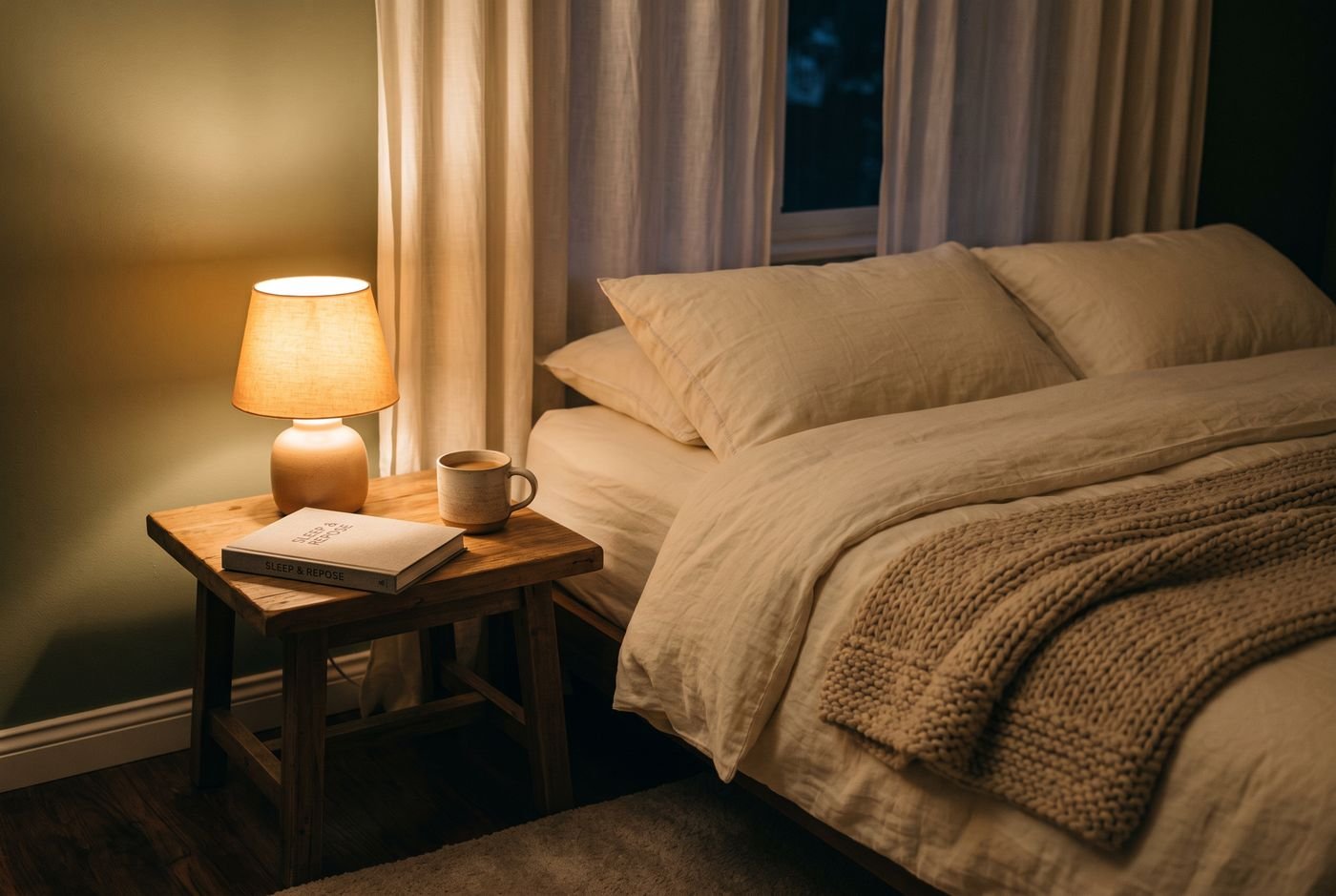
Bright overhead lighting in the evening can keep your body feeling alert. Switching to lamps, dimming overhead lights, or using warmer-toned bulbs in the hour before bed is a simple change that many people find makes a noticeable difference to how ready they feel to rest.
It requires no time, no effort, and no equipment beyond a lamp you probably already own.
Make a warm drink
There is something genuinely settling about the ritual of making and drinking a warm, caffeine-free drink in the evening. Herbal teas, warm milk, golden milk, or a simple mug of hot water with lemon — the specific choice matters less than the habit of having something warm and calming that marks the evening as yours.
Do a light tidy
Waking up to a reasonably tidy space is one of those small things that can make the next morning feel easier before it has even started. Spending five to ten minutes putting things back, clearing the kitchen counters, or setting out what you need for tomorrow is low-effort in the evening and surprisingly high-payoff in the morning.
This connects directly to your morning routine — a settled evening environment makes the next day's start calmer. See our guide to creating a morning routine you actually enjoy for more on this.
Step away from screens earlier
You have probably heard this before, but it is worth repeating because it is one of the most commonly cited things people notice when they try it: putting your phone or tablet down 30 to 60 minutes before bed tends to make the transition to sleep feel easier for many people.
If a complete screen cutoff is not realistic for your life, even reducing the intensity helps — switching from something stimulating to something quieter, or moving from your phone to a television in another room.
Read something enjoyable
Reading before bed is one of the oldest wind-down habits there is, and for good reason. A physical book or e-reader with a warm display draws your attention inward in a way that is quite different from scrolling. Fiction often works particularly well for this — it pulls you gently out of your own day and into someone else's world.
Even ten pages counts. You do not need to read for an hour for this to feel beneficial.
Gentle movement or stretching
Light stretching in the evening — nothing intense, just gentle movement — can help your body release the accumulated tension of sitting, standing, or moving through a full day. A ten-minute routine focused on the shoulders, hips, and lower back is a good starting point.
If you enjoy this kind of thing, our move and feel good section has ideas for keeping movement gentle and enjoyable at any time of day.
Skincare or a simple self-care ritual
Even a basic skincare routine — washing your face, applying moisturiser — can become a reliable wind-down signal when you do it consistently in the evening. The routine itself becomes a cue that the day is ending. It does not need to be expensive or time-consuming to be effective as a ritual.
For more ideas like this, our self-care section has practical, low-key approaches to looking after yourself without it becoming another task on the list.
How to put a routine together
A useful evening routine tends to have a loose three-part shape: something that closes the day, something calming, and something that prepares for tomorrow. You do not need to follow this rigidly, but it is a helpful frame.
- Close the day: Shutdown ritual, writing tomorrow's priorities, tidying up
- Calm down: Lower lights, warm drink, reading, stretching, gentle self-care
- Set up tomorrow: Lay out clothes, prepare what you need, check your plan for the morning
The whole thing could take 20 minutes or an hour, depending on what you include. Either is fine. The rhythm matters more than the length.
Keep in mind
Your evening routine will not always go to plan. Evenings are often where the unpredictable parts of life land — a late meeting, a child who needs attention, an unexpected call. Build in flexibility and treat a simplified version of your routine as still counting. Something is always better than nothing.
Tracking what works for you
If you want to figure out which habits are actually making a difference, it helps to track them for a few weeks. A simple habit tracker lets you see patterns — which evenings felt calm, which felt rushed, and what the difference was.
You do not need anything fancy. A notebook with checkboxes works perfectly. Our guide to using a habit tracker to stay consistent walks through a simple approach you can start tonight.
Journals and planners
A dedicated evening journal or planner — even a simple undated one — gives you a consistent place to jot tomorrow's priorities and note what went well today. Look for a lay-flat binding, lined or dot-grid pages, and a compact size that fits a nightstand.
See optionsWarm-light lamps
A small bedside or table lamp with a warm colour temperature makes it practical to dim your environment in the evening without sitting in the dark. Look for something with an adjustable brightness setting, a compact footprint, and a simple switch you can reach easily from your seat or bed.
See optionsWhere to go from here
Start with one thing that sounds genuinely appealing from this list — not the one that sounds most impressive, the one that sounds most doable. Do it for a week. See how the evenings feel. Then, if you want to, add one more thing.
Your evening routine and your morning routine work together, so improving one often improves the other. If you have not already, take a look at our ideas for creating a morning routine you actually enjoy — and for a weekly reset that ties both together, our Sunday reset ideas give you a simple framework for planning ahead. The better routines section of the site has more ideas whenever you are ready.
Common questions
How early should I start my evening routine?
It depends on when you want to be in bed. Working backward by 30 to 60 minutes is a good starting point for most people. Even a 20-minute wind-down at the end of the day can make a noticeable difference to how quickly you feel ready to rest.
Do I need to do the same things every evening?
Consistency helps, but it does not have to be rigid. Having a loose sequence — something to signal the day is wrapping up, something calming, something that prepares you for tomorrow — is more useful than an identical list performed in strict order every night.
What if I have very little time in the evenings?
Even five or ten minutes of intentional wind-down can help. Focus on one or two things that genuinely help you feel less 'switched on' — dimming the lights, putting your phone down, or making a warm drink — rather than trying to fit in a full routine.
A quick reminder
Health & Wellness Talk shares general wellness and lifestyle ideas only. Nothing here is medical advice, and we're not a substitute for a qualified healthcare professional who knows your situation.