This article contains affiliate links. If you buy through one of them we may earn a small commission at no extra cost to you. How this works.
You do not need a dedicated gym room — or even a full spare room — to build a consistent movement routine at home. The accessories that work best for small spaces tend to be versatile, compact to store, and useful across a range of movement types, so they earn their floor space even when a studio apartment is all you have.
What to look for
The challenge with small-space fitness accessories is finding options that earn their keep. Something that requires assembly, takes up a corner permanently, or only does one thing is a harder sell when space is limited. The criteria below focus on what actually matters when you are working within a constrained footprint.
Storage footprint when not in use
This is the most important consideration for small spaces. A resistance band set takes up less space than a paperback book. A foam roller takes up roughly the space of a tall water bottle. A set of adjustable dumbbells can replace an entire rack. Before buying anything, ask yourself: where will this live when I am not using it? If the honest answer is "on the floor in the middle of the room," reconsider whether the item suits your setup.
Versatility across movement types
In a small space, accessories that do multiple things are more valuable than those that do one thing very well. A long resistance band can be used for upper-body pulling movements, lower-body work, and mobility exercises. A yoga mat works for stretching, bodyweight training, and floor-based core work. Prioritize items with a wide range of uses.
Noise and impact considerations
Apartment living often means thinking about neighbors below. High-impact movements — jumping, dropping weights — can be disruptive. Look for accessories that support lower-impact options or come with noise-reducing features (thick mats, soft-sided equipment). A jump rope, for example, can be used with an anti-fatigue mat to reduce the impact sound.
Weight and adjustability
Fixed-weight dumbbells take up more space per pound than adjustable ones. Adjustable dumbbell sets that replace a full rack of weights are genuinely useful in small spaces, though they come at a higher price point. Resistance bands offer a range of difficulty levels in a format that weighs almost nothing and stores in a small pouch.
Ease of setup and pack-away
If setting up to exercise takes more than two or three minutes, it becomes a source of friction that makes skipping easier. The best small-space accessories can be out and ready in under a minute. A yoga mat that stays rolled in the corner of the room, resistance bands hanging on a hook, a jump rope in a drawer — these are setups that remove the barrier rather than adding to it.
Fitness accessory picks for small spaces
Resistance band set (loop and long band varieties)
A set of looped resistance bands in multiple resistance levels, paired with one or two long resistance bands, covers an enormous range of movement options. Looped bands work well for lower-body exercises and glute work; long bands are useful for upper-body pulling movements, rows, and assisted stretching. The entire set rolls into a small pouch and weighs almost nothing.
- Extremely compact storage — fits in a drawer or small bag
- Wide range of exercises across difficulty levels
- Inexpensive relative to nearly any other fitness equipment
- Lightweight enough to take when traveling
- Bands can snap over time, especially with heavy use — inspect regularly
- Resistance is less precise than free weights for strength progressions
Extra-thick non-slip yoga mat (6mm or more)
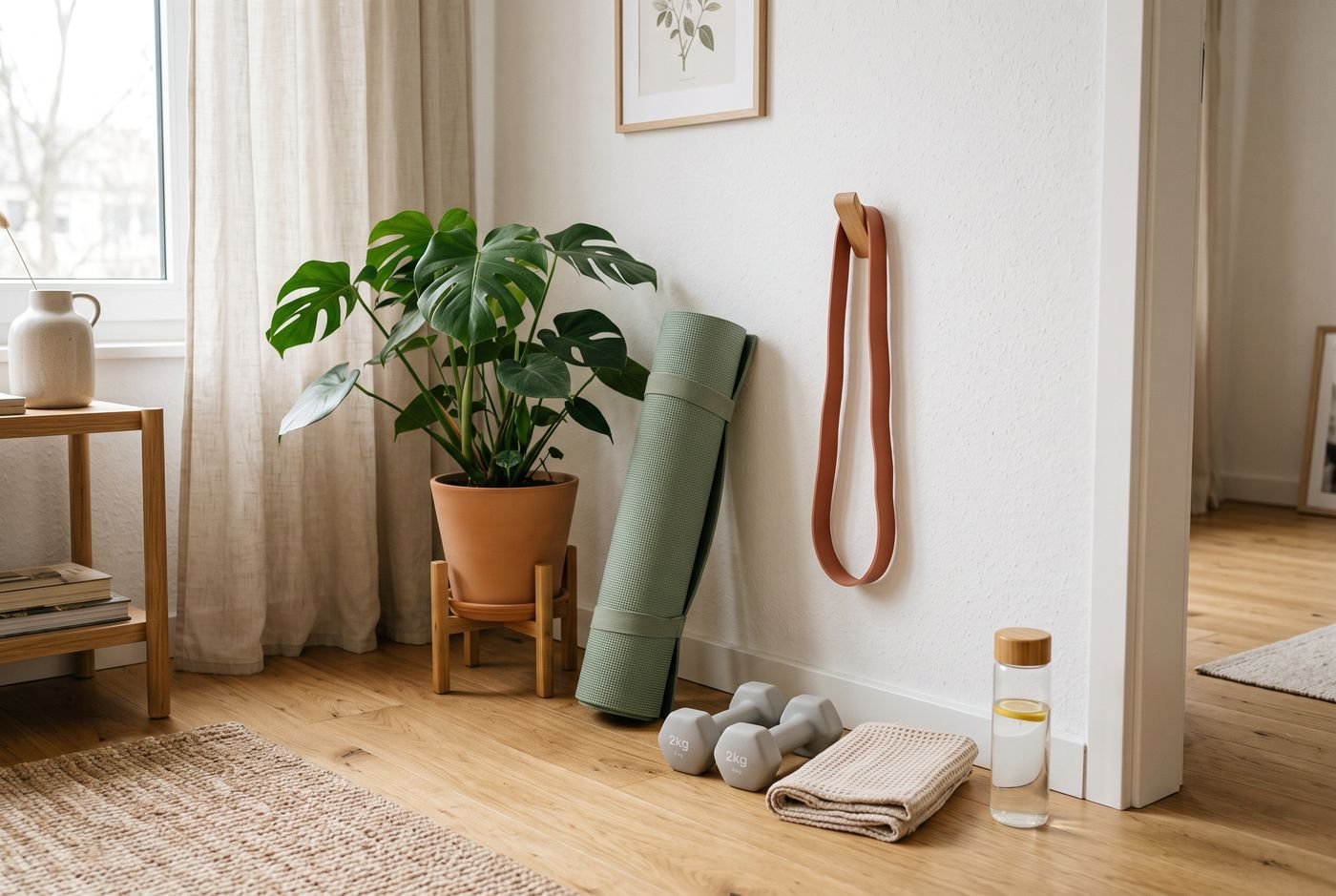
A thicker yoga mat — 6mm or above — provides enough cushioning for floor-based core work, bodyweight exercises, stretching, and yoga, while still being firm enough for balance-based movements. The non-slip texture matters for exercises that involve shifting your weight. Look for a mat that rolls up with a carry strap so it can lean against a wall in a corner without taking up floor space between sessions.
- Defines your workout space visually and physically
- Works for a wide range of movement types
- Rolls up to lean against a wall — no floor footprint when stored
- Thicker mats are heavier and slightly bulkier to carry
- Some materials require hand washing rather than machine washing
Jump rope with adjustable cable
An adjustable jump rope — either speed cable or weighted handles — stores neatly in a drawer and supports a surprisingly effective cardio session in a 6x6 foot space. Look for an adjustable cable length so you can set it to your height, and soft or rubber handles that are comfortable to hold for longer sessions. A jump rope used on a thick mat or in a room with reasonable ceiling height is a low-cost alternative to larger cardio equipment.
- Tiny storage footprint — fits in a coat pocket
- Very affordable
- Adjustable to different heights and skill levels
- Impact noise can be an issue in apartments — best used with a thick mat underneath
- Requires sufficient ceiling height
Adjustable dumbbell set (replaces 5–30+ lb rack)
A dial-adjust or pin-select adjustable dumbbell set occupies roughly the footprint of two standard dumbbells while replacing an entire rack's worth of weight options. These are a genuine space-saver for anyone who wants to do resistance training at home without dedicating a corner to a full set of fixed weights. They are a mid-range to premium investment upfront but often cost less than a multi-piece fixed set when the equivalent weight range is compared.
- Replaces an entire rack of dumbbells in a very compact footprint
- Quick weight adjustment supports moving between exercises smoothly
- Long-lasting investment that can grow with your fitness level
- Higher upfront cost than fixed dumbbells or bands
- Mechanism can be delicate — avoid dropping from height
Foam roller (standard or travel size)
A foam roller is one of the most accessible recovery and mobility accessories for home use. A standard 36-inch roller is the most versatile for the back and legs; a shorter 12–18 inch travel version stores more easily and is sufficient for most common uses. Look for a medium-density option if you are new to foam rolling — very firm rollers can be uncomfortable for beginners. Used before or after movement sessions, it may help you feel more comfortable maintaining a routine.
- Low cost and very easy to use with minimal instruction
- Travel-size versions store upright in a corner with almost no footprint
- Useful before and after any type of workout
- Full-length versions take up more floor space than travel versions
Foam rollers, resistance training, and high-impact activities such as jump rope are not appropriate for everyone. If you have an existing injury, joint condition, or have been advised to limit physical activity by a healthcare provider, consult with a qualified professional before starting or changing a home exercise routine.
Sliding discs (furniture sliders or fitness-specific)
Sliding discs — either purpose-made fitness versions or simple furniture sliders — sit flat and take up almost no storage space. They add a useful element of instability to bodyweight exercises: lunges, mountain climbers, and plank variations all become meaningfully more challenging. One side typically works on hard floors, the other on carpet. These are an inexpensive and nearly weightless way to add variety to a mat-based routine.
- Flat — can be stored under a mat or in a drawer
- Adds significant exercise variety at very low cost
- Dual-surface design works on most floor types
- Only useful for floor-based movements — single-use in that sense
- Not suitable for certain joint conditions — check with a professional if unsure
Compact suspension trainer (door-anchor style)
A door-anchor suspension trainer uses a single anchor point — the top of any standard door — to support a wide range of bodyweight exercises. When not in use, it folds down to a compact roll that fits in a medium-sized bag. These are popular with people who travel frequently but want to maintain a consistent movement routine in hotel rooms or spare bedrooms without carrying heavy equipment.
- No floor space required during storage — hangs on a door
- Supports a full-body workout from a single anchor point
- Packs into a small roll for travel
- Requires a standard door with a reliable anchor — not all doors work
- Takes a short learning curve to set up and use correctly
Quick comparison
| Option | Best for | Price bracket | Worth it if… |
|---|---|---|---|
| Resistance band set | Most people in most small spaces | Budget | You want maximum versatility with minimal storage and cost |
| Extra-thick yoga mat | Any floor-based movement routine | Budget to Mid-range | You want a defined, cushioned workout surface for any type of movement |
| Jump rope | Compact cardio with no equipment footprint | Budget | You want a cardio option that stores in a drawer |
| Adjustable dumbbell set | Resistance training in limited floor space | Premium | You want to replace a full dumbbell rack with two items |
| Foam roller | Recovery and mobility work | Budget to Mid-range | You want to support a movement routine with easy-to-use recovery |
| Sliding discs | Adding variety to mat workouts | Budget | You want more challenge from bodyweight movements without new equipment bulk |
| Suspension trainer | Travel use or door-anchor setups | Mid-range | You need a full-body option that travels and stores without taking floor space |
How to actually use these in your routine
Small-space fitness accessories work best when they are accessible without effort. A mat leaning against the wall, bands hanging on a hook near the mat, a foam roller sitting upright in the corner — when these are visible and ready in under thirty seconds, the barrier to starting a session drops significantly. Compare this to digging equipment out of a closet, and the difference in follow-through can be substantial.
If you are building a home movement routine from scratch, starting with just a mat and a resistance band set covers a wide range of foundational movements: squats, hinges, pushes, pulls, and core work. Add a foam roller for before and after, and that is a genuinely complete setup. For ideas on how to fit more movement into a regular day without a structured workout, see easy ways to add more movement to your day.
Try this
Set out your mat the night before so it is already unrolled and in place when you wake up. Removing even one step from the beginning of a workout can make a meaningful difference in whether you start it.
Once a basic routine feels consistent, you can add accessories that address specific goals or add variety. Adjustable dumbbells are worth considering when resistance bands start to feel insufficient. Sliding discs and a suspension trainer add a different type of challenge without requiring much additional space. The goal is a small, well-chosen collection that stays in use — not a growing pile of equipment that never quite gets unpacked.
Free printable
Download a simple weekly movement planner from our free printables — a quick way to map out when and what you plan to do each week.
Get the Wellness Starter PackBuilding a setup that sticks
The best small-space fitness setup is not the most impressive one — it is the most consistent one. A mat on the floor and a set of bands used three times a week will do far more than a premium collection that never comes out of the closet. Start with what fits your space, your budget, and your current routine. Explore more ideas for staying active at home in our move and feel good section, and if you are looking for ways to build the habit itself, how to create a simple daily wellness routine is a practical place to start.
Common questions
What is the most useful piece of fitness equipment for a small apartment?
Resistance bands are often cited as the most space-efficient option because they are lightweight, take up almost no storage space, and can be used for a wide variety of movements targeting different muscle groups. A good quality set is also relatively affordable compared to most other fitness equipment.
Do I need a dedicated space to work out at home?
Not necessarily. Many bodyweight and accessory-based routines require only the space of a yoga mat — roughly 2 by 6 feet. A cleared area of living room or bedroom floor is enough to get started with the types of accessories covered in this guide.
Are home fitness accessories good for beginners?
Many of the accessories in this guide — resistance bands, yoga mats, and jump ropes, for example — are well-suited to beginners because they allow you to start with lower intensity and gradually increase challenge. If you are new to exercise or returning after a break, starting with bodyweight movements alongside a quality mat is a low-barrier entry point.
A quick reminder
Health & Wellness Talk shares general wellness and lifestyle ideas only. Nothing here is medical advice, and we're not a substitute for a qualified healthcare professional who knows your situation.